1 month ago
48
1 month ago
48
Fishers, surfers and divers say they should have been warned about the towing of a huge whale carcass along a 20km stretch of coast south of Sydney, which resulted in increased shark activity.
A Wollongong City councillor is demanding a review into the operation to remove the sperm whale from a remote beach in the Royal national park last week.
“What we saw on Friday was a clumsy and poorly communicated operation to remove a sperm whale from Era beach … to Bellambi boat ramp,” Greens councillor Jess Whittaker said.
“The community was placed in an unfair situation, the whale was not treated with the respect it deserved, and our beaches are likely to experience increased shark activity for weeks as a result of this mismanagement.”
Whittaker said a government review should be held “in collaboration with all agencies involved”.
The councillor argued there was a failure to warn people in the water on Friday that the carcass was being towed, with a “lack of any media plan”. She said the Bellambi boat ramp was open that morning, meaning fishers were later stranded at sea when the whale was brought ashore.
“The review should also examine worker safety and the type of equipment used to lift the whale from the boat ramp,” she said.
“When this equipment failed to lift the large carcass, it was instead used to break it apart and load it piece by piece, causing a significant slick of burley.”
A challenging operation
The decomposing sperm whale was discovered on Saturday 25 April, after washing on to a rock platform at Era beach in the Royal national park.
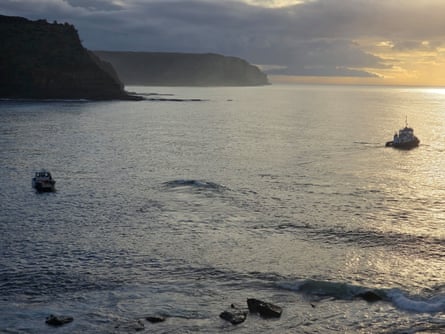
Due to a lack of vehicle access, the National Parks and Wildlife Service (NPWS) engaged a contractor to deploy a tugboat with a 60-tonne towing capacity. The operation was planned around tides to enable the removal of the estimated 20 to 25-tonne, eight-metre-long carcass.
“This was extremely difficult due to the advanced state of decomposition,” a NPWS spokesperson said.
“It was not feasible to simply tow [the] carcass out to sea and release it, as this creates a shipping hazard which can last for several weeks. This may have resulted in it washing to another location with more complex removal challenges.”
NPWS said it consulted the local Aboriginal community to ensure cultural values were considered, and identified Bellambi boat ramp as the most suitable extraction point based on advice from Wollongong city council.
The ramp offered the best water and road access for a carcass of “leviathan proportions”, the parks and wildlife service said.
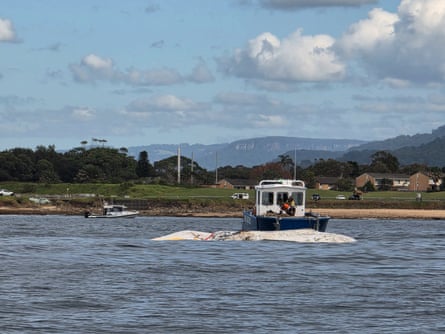
At dawn on Friday, the whale wrapped in straps was pulled from the rocks before being towed more than 20km south to Bellambi. After being broken apart, it was loaded into skip bins and transported by road to the Whytes Gully waste facility.
‘No notification and that was dangerous’
According to SharkSmart, Surf Life Saving NSW advised on Friday that a shark was observed at Bellambi beach at 11am. The alert stated that the water was evacuated and the beach closed.
The ABC reported 16 sharks were sighted in the area over the weekend. SharkSmart reported a bull shark at Woonona Point and a 3.73-metre tiger shark that was tagged and released from a SMART drumline at Corrimal beach.
Local spear fisher Darren Bissett said his Friday morning began like any other off the coast at Bellambi.
Having checked the weather, rip charts and local social media channels for potential hazards, he and his dive buddy were spearfishing a shallow reef.
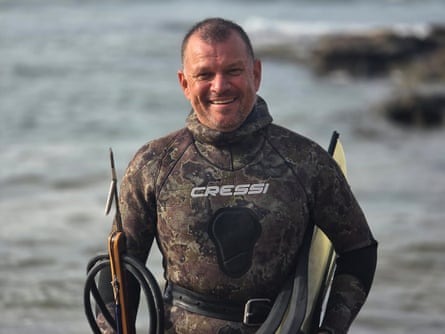
They were unaware that the whale carcass was being towed just 500 metres away, bringing with it feeding sharks.
“We had no notification, and that was a particularly dangerous situation that we were foisted into through a complete lack of correspondence by the people performing the action,” Bissett told the Guardian.
The divers were warned about the incoming hazard not by authorities but by a commercial diver who had intercepted radio chatter about the carcass. He abandoned his work and then raced over to warn them after spotting their dive flag.
“I had a smirk under my mask thinking, these guys are pulling my leg,” Bissett said.
Then he saw the tugboat and the carcass breaching the waves. He said nearby, unaware locals were swimming and surfing at Bellambi rock pool.
“I was gobsmacked,” he said this week, adding he saw multiple sharks in the water near the carcass at the boat ramp.
Bissett said maritime authorities didn’t sound alarms or approach his vessel.
“Swimming when there’s a feeding event happening elevates the risks considerably. You are confronted with species that are very aggressive in feeding scenarios, which was completely avoidable,” he said.
Marc Robson, president of the Woonona Boardriders Club, said he discovered the carcass was at Bellambi by calling the council on Friday morning.
Having heard rumours on Thursday evening, he sought clarification from the council and surfing governing bodies but received no formal communication.
“There were significant safety concerns, particularly the increased risk of shark activity associated with towing a carcass along the coastline,” Robson said.
“Many surfers, swimmers and divers across multiple beaches … were likely unaware of the situation.”
The club was forced to cancel its first championship event of the year, scheduled for Sunday.
“Emotions have understandably been heightened given the potential safety implications,” he said. Robson said the community’s response has been one of “concern and confusion” over the lack of communication.
Finger pointing and safety concerns
After the operation, there has been intense discussion about who was responsible for warning the public about potential shark activity as the carcass was towed.
A NPWS spokesperson said that while they managed the removal of the carcass, Wollongong city council, as the local land manager, was responsible for beach closures, signage and public safety warnings, with the support of Surf Life Saving NSW.
Parks and wildlife said council and life saving staff were engaged from the outset, including on Tuesday 28 April when NPWS first contacted the council to plan the Bellambi retrieval.
However, the council said that NPWS was the lead agency directing communications. The council said it received an operational timeline from NPWS on Thursday suggesting the whale would not arrive at Bellambi until Friday afternoon.
The council claims NPWS told it the timeline was not for further distribution.
A spokesperson for SLSNSW said NPWS initially notified three affected surf clubs that a removal attempt would occur “in the coming days” but no destination was advised.
NPWS stated it updated Surf Life Saving before 8am on Friday – once the whale was successfully removed from the rocks at Era beach.
The council said when it became aware of the “updated timeframe” on Friday morning it contacted key local representatives to ensure they were aware of potential increased shark activity.
“Local Surf Life Saving clubs and council also used social media on Friday morning to advise the community of the increased likelihood of shark activity associated with the NPWS operation.”
SLSNSW said when it became aware that the carcass was being moved to Bellambi it “immediately notified Wollongong city council and supported them in the closure of all impacted beaches”.
It also launched drones for “shark surveillance”.
But SLS Illawarra was reportedly unaware the carcass was on the move until local fishers reported it arriving at Bellambi at about 10.30am on Friday. SLS Illawarra was only emailed by the council at 11am, the ABC reported.
‘It was quite distressing’
Bissett said beyond the immediate danger to water users, “the whales are also a sacred animal to our Indigenous brothers and sisters”.
“It was quite distressing for a lot of people witnessing it and hearing about it,” he said.
Towing the carcass along the coast “was a very poor action plan,” he said.
Wollongong council acknowledged “the removal of a deceased whale is a complex and sensitive process”.
“Whales hold significant environmental and cultural importance in Wollongong, and their loss is felt deeply by the community and taken seriously by council,” the spokesperson said.
Wollongong’s lord mayor, Tania Brown, has requested an urgent meeting with the state ministers for the environment and agriculture, and NPWS, to establish protocols for future operations.
“As is standard practice, NPWS will be reviewing the operation with the other parties involved … to identify any lessons to be learned to improve effectiveness and efficiency,” the parks and wildlife service spokesperson said.
With whale populations recovering since hunting bans, Whittaker warned that coastal communities would inevitably see more carcasses washing ashore.
“These situations must be handled in a more sensitive and culturally appropriate way,” she said.