2 months ago
136
2 months ago
136
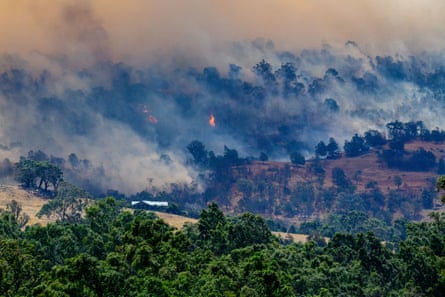
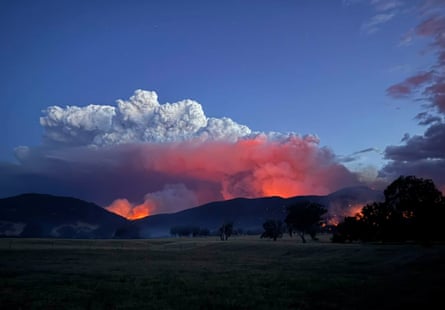
Australian authorities are assessing the damage after one of the worst heatwaves in years resulted in bushfires igniting across the country’s south-east, with hundreds of homes and structures lost, thousands of hectares burned and entire towns evacuated.
A state of disaster remained in place across much of Victoria on Sunday as thousands of firefighters and emergency service workers continued to battle blazes that were “expected to rage “for weeks”.
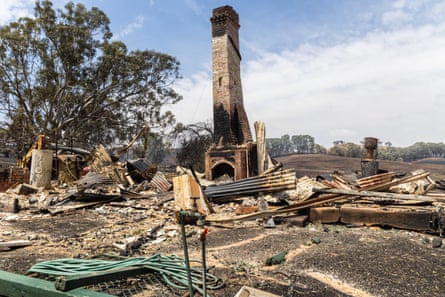
More than 300 structures had been destroyed with more than 80 homes lost, authorities said, as fires burned 350,000 hectares of bushland. To date, no lives had been lost.
The prime minister, Anthony Albanese, told Victorians: “We’ve got your back, not just during this crisis, but through the recovery as well.”
Albanese announced disaster recovery funding to be provided jointly with the state government, which now totals $20m.
Fifteen emergency warnings were in place at midday on Sunday, with residents urged to “leave immediately” or “take shelter now”, according to VicEmergency, as major bushfires in the Otways, Longwood in central Victoria and north-east on the New South Wales border remained out of control.
Victoria’s premier, Jacinta Allan, said the state was facing “another difficult day” with 32 active fires.
“We are not through the worst of this by a long way,” she said. “If you are told to leave by the emergency services, do so. Stay safe and support our firefighters”.
The state’s emergency management commissioner, Tim Wiebusch, said it was disappointing to see spectators travelling to bushfire-affected areas.
Sign up: AU Breaking News email
“Please do not enter those fire-impacted zones. Stay well away from them until they are safe,” he said. People were warned that, even after a fire had passed, falling tree limbs could prove deadly.
Authorities were beginning to assess property losses, Wiebusch said. More than 47 homes and three businesses were lost at Ravenswood and Harcourt, fires at Natimuk had destroyed 30 houses and 40 sheds, and about 150 structures were lost at Longwood. One house and 12 sheds were destroyed at Mount Mercer.
Many areas were still too dangerous to conduct loss and damage assessments, the commissioner said.
Thirteen relief centres were open across the state, offering support to affected communities.
A statewide total fire ban remained in place, with high fire danger continuing across the Mallee, Wimmera, northern, north-central and north-east districts, due to dry and windy conditions.
Federal and state authorities were working to provide food and fodder for surviving livestock, with active fires continuing to restrict road access.
With smoke and ash from the fires likely to drift, air quality advice was issued statewide, encouraging people to stay indoors and limit prolonged or heavy physical activity.
“Your nose is an excellent smoke detector,” VicEmergency advised. “If you can smell smoke, take the necessary precautions to protect your health.
“People more sensitive to smoke are those with a heart or lung condition, including asthma; people over the age of 65 years; infants and children; and pregnant women.”
Victoria’s Environment Protection Authority forecast widespread “poor” air quality, with “very poor” quality observed between 7am and 8am at stations in Bendigo, Bright and Mount Clear.
Residents of Harcourt, a town in the central highlands, were told not to drink the tap water due to the risk of contamination. The water corporation Coliban Water was unable to access a burst water main due to the fires. The “do not drink” advice covered drinking, food preparation, preparing baby formula, brushing teeth or making ice.
Angus Hines, a senior meteorologist at the Bureau of Meteorology, said after three days of “scorching hot temperatures” in Victoria, the heat had mostly subsided, with many places now experiencing cooler-than-average temperatures for January.
“It’s been a real flip of the switch,” he said on Sunday.
Victoria could expect mild conditions over the coming days, he said, but no significant rain was expected until later in the week.
“We may see some wet weather moving into parts of southern and eastern Victoria on Thursday or Friday. Current forecasts suggest that most of that rainfall is going to be on the southern side of the ranges and out over the Gippsland area.”
Meanwhile, in Australia’s north, residents were being “smashed” by heavy rain and fierce wind after Tropical Cyclone Koji crossed the coast in Queensland.
Australia experienced its fourth-warmest year on record in 2025, with average temperatures up 1.23C nationally, according to the BoM. The climate crisis has increased the frequency and severity of extreme weather events, including heatwaves and bushfires.