4 hours ago
7
4 hours ago
7
‘I love parties,” says France-Lise McGurn, “but they’re complicated, and there’s a time when you leave.” Her new show at Dundee Contemporary Arts, called The Charm Offensive, carries her dynamic, vital paintings into a new era – and on an unprecedented huge scale. Grappling with grief, the passing of time, and the paradoxes and slippery truths of modern womanhood, the work chases the desire to be present, balancing the fun of the party with the melancholy of leaving it.
McGurn was born and raised in Glasgow and studied painting in Dundee, so this show is something of a homecoming. As a student, she lived three doors down from DCA. Although she knows nostalgia can be a “dirty word” among artists, McGurn says that “a melancholic grappling with the past is part of painting”. She has always worked from extensive source material, but for this show, she has allowed that archive of images to be visible to viewers.
Film stills, magazine ads, family photos, and other ephemera that inspire her find their way on to the canvas for the first time. Working with a studio in Glasgow, she has the images blown up and printed on canvases, resulting in a lo-fi, retro aesthetic. Sometimes, the images are entirely obscured by paint, existing as ghosts beneath another composition. In other works, McGurn adds very little paint to the canvas, allowing the printed image to dominate.
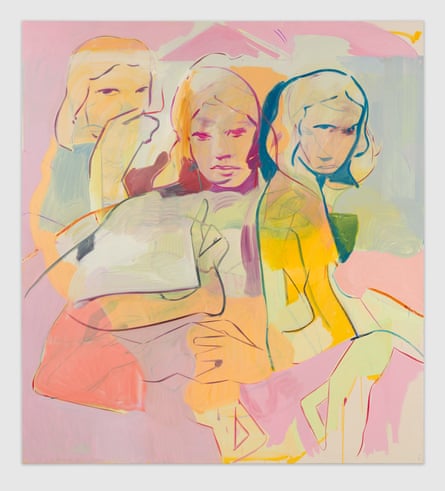
In one large work, Motor, an image of the van her family drove throughout her childhood is printed on the canvas. On top of it, McGurn has painted silhouettes of her young daughter and her mother, the artist Rita McGurn, who died in 2015. It becomes a circular portrait of time passing, of intergenerational inheritance and legacy. As McGurn and I talk, her mother seems almost to be in the studio with us: her influence on her daughter is so evident.
“She had this radical feminist idea that you don’t wait for the studio,” McGurn says. “Painting can happen around real life – and it had to.” McGurn hasn’t taken this as literally as her mother, who painted most of the inside of their family home: we sit among the more usual detritus of a working artist’s studio in east London. But the ethos of using what you have and figuring it out as you go along is fundamental to McGurn.
In that vein, the DCA show also includes stuff for the first time: McGurn has transported the paint-covered sofa from her studio, hoping that visitors will feel inclined to settle into it and spend time in the space. There are painted wallets and other ephemera, partly there to revel in the luxury of having such a huge gallery space to fill with anything and everything – but also there to reaffirm her mother’s maxim that anything can be painted on. There is a spatial element, too. “I want people to come in,” she says, “and stay and spend time there and feel like it’s for them.”
after newsletter promotion
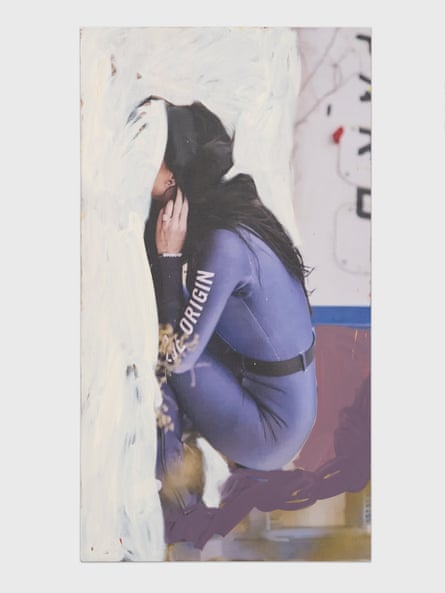
Sexy, dynamic female figures have always characterised McGurn’s work. She often features her own body as a reference. “It’s my body,” she says with a laugh, “and I’ll use it.” But by the time the figures reach the canvas, they have become what McGurn calls glyphs: abstracted, classical symbols of the female figure rather than portraits of an individual. She bristles at any easy reading of them as purely hedonistic and fun. “I think there is a much harder, more subversive relationship women have to their bodies now,” she says.
One of the printed, archival images she includes in this show depicts Katy Perry kissing the Earth after returning from space – a photo that went viral, possibly for its absurdity. “This is an image of a woman coming down and kissing the Earth that, by going into space, she has done something to harm,” McGurn says. There is a knife-edge balance in McGurn’s work between tongue-in-cheek irreverence and deadly serious critique, which makes her paintings feel full of real-life contradictions and anomalies.
Her perky pastel colour palette is often read for its surface, too. “Like, ‘Oh, how feminine!’’’ she laughs. It seems to be such a dead-end, one-liner reading: if work is feminine, that’s all it is. McGurn is as interested in that reality as she is in turning it on its head. For her, the palette she has developed comes from the materiality of her paints and the textures they produce on the canvas. Her aesthetic raises questions about the line between decoration and depth, surface and meaning, looking and being looked at.
In fact, McGurn’s paintings are far more than that: they’re invitations. “Get in this painting and figure it out with me,” she says. The many paradoxes of modern life that dog us all seem to come to rest on McGurn’s canvases, tangled up but somehow in balance. Like her, the paintings exude a generous, deeply human warmth.