2 months ago
98
2 months ago
98
The Kremlin said on Tuesday it was pleased that Hungary’s prime minister-elect, Péter Magyar, appeared open to pragmatic dialogue, as Moscow adopts a wait-and-see approach after the election loss of its closest partner in Europe, Viktor Orbán.
“For now, we can note with satisfaction, as far as we understand, his [Magyar’s] willingness to engage in pragmatic dialogue,” said the Kremlin spokesperson Dmitry Peskov. “In this instance, there is mutual willingness on our part, and we will then proceed to take our cue from the specific steps taken by the new Hungarian government.”
Moscow, a day earlier, did not congratulate Magyar on his election victory. Instead, Peskov made clear that Hungary no longer enjoys any special status and now falls into the category of “unfriendly countries” alongside the rest of Europe.
But the scale of Orbán’s defeat has left Moscow with little choice but to acknowledge the loss of a key partner in Europe. “Hungary made its choice. We respect that choice,” Peskov said on Monday.
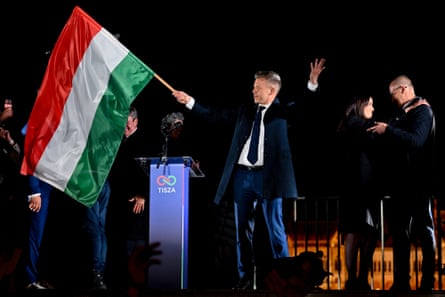
Moscow appears to be playing down the loss of a key ally in Europe, striking a tone reminiscent of its messaging after the fall of Bashar al-Assad. Then, the Kremlin moved quickly to distance itself from Assad as it sought to preserve whatever leverage it could with Syria’s new leadership.
“We were never friends with Orbán,” said Peskov, adding that Moscow remained open to dialogue and to building good, mutually beneficial relations with Budapest.
Magyar signalled in his first statements on Monday that a dramatic rupture with Russia should not be expected. He suggested Hungary would maintain a pragmatic foreign policy – continuing to buy Russian oil and remaining cautious on Ukraine – even as he seeks to rebalance relations with the west.
“We cannot change geography,” he told reporters, adding that Hungary would need to find a way forward on energy imports, including those from Russia.
The incoming prime minister will inherit a struggling Hungarian economy that remains heavily dependent on Russia, which supplies more than 80% of its fossil gas and crude oil – a reliance that is expected to give Moscow leverage in Hungary for years to come. “Russia will be there, Hungary will be here. But we will try to diversify,” Magyar said.
But he has made it clear that he has little interest in playing the role Orbán did for Putin. Most notably, the incoming prime minister left no room for interpretation that he sees Russia as the aggressor in the conflict with Ukraine.
“If Vladimir Putin calls, I’ll pick up the phone,” he said. “If we did talk, I could tell him that it would be good to end the killing after four years and end the war.”
It marked a notable break from Orbán’s rhetoric towards Russia’s full-scale invasion. For years, Orbán and Putin made no secret of their mutual admiration – and usefulness to one another – both in public and in private.
Since the start of Russia’s war in 2022, Hungary has systematically worked to blunt the EU’s response – lobbying to weaken sanctions, repeatedly blocking aid to Kyiv, and most recently vetoing an EU loan worth billions of euros that Ukraine urgently needs to withstand Russian aggression.
Behind closed doors, according to leaked phone calls, Orbán had gone so far as to tell the Russian leader: “I am at your service.” Russian intelligence and state-linked media were also reported to have tried to sway the vote in Orbán’s favour.
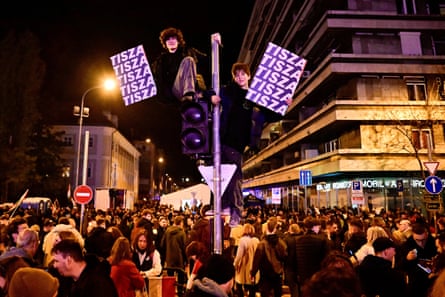
Russia’s loss of political capital was also felt on the streets of Budapest and beyond, where chants of “Ruszkik, haza” (Russians, go home) echoed long into the night in celebration. The slogan, rooted in the Hungarian Revolution of 1956, was revived by Orbán’s critics during the campaign as a protest against his government’s close ties to Moscow.
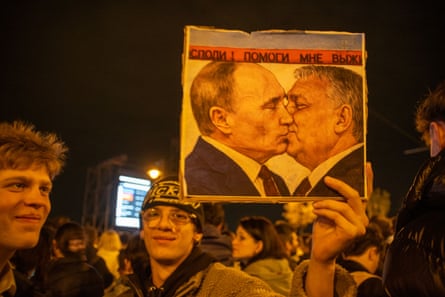
For the Kremlin, the Hungarian election result was a sobering moment, said Alexander Baunov, a political analyst at the Carnegie Endowment for International Peace. He argued that Orbán’s ousting would reinforce a long-held view among more hawkish elites that betting on Kremlin-friendly leaders in Europe – where democratic systems can still produce sudden changes of government – is a risky strategy.
“In Moscow, the takeaway is that only truly authoritarian systems are reliable partners, and hopes that the west might one day resemble Russia are illusory,” Baunov said.
That lesson, Baunov argued, extended well beyond Hungary. “It also serves as a reminder not to place too many bets on figures like Donald Trump. He may disappear as suddenly as he emerged,” he added.
Some pointed to Trump’s weakening polling numbers in the US and questioned whether the Kremlin had a strategy if the US president was succeeded by a conventional politician who was more hostile to Russia.
“I wonder whether there’s a clever plan for that,” wrote Fighterbomber, a Russian military aviation Telegram channel linked to the air force. “In Trump’s place would come an ordinary, unremarkable American president who will supply Ukraine with every weapon it needs and offer every form of support available.”
But the prevailing conclusion across Russia’s sprawling ecosystem of commentators and pro-war bloggers was that Moscow could rely only on itself in the war in Ukraine.
“Neither the Hungarians, nor the Slovaks, nor anyone else will be breaking through the enemy’s defences for us,” wrote the pro-Kremlin Komsomolskaya Pravda reporter Alexander Kots, referring to the Slovakian prime minister, Robert Fico, who will now be the most pro-Moscow leader in the bloc.
“By the fifth year of the war, it should be clear that external factors have only an indirect bearing on our situation in Ukraine,” Kots added.