3 months ago
149
3 months ago
149
It’s the question most often posed to artists: where do you get your ideas from? David Haig’s answer is: I ask Google. Preserve the mystique, man! Haig is celebrated both as an actor (Killing Eve, The Thin Blue Line) and playwright, whose 2004 hit My Boy Jack was adapted for TV and whose follow-up Pressure is now a forthcoming Hollywood movie. His mouthwatering latest play dramatises the friendship between writer and spiritualist Arthur Conan Doyle and escapologist and rationalist Harry Houdini. It’s such a fascinating double act, one assumes Haig must have long nursed an interest in their story. The truth is more prosaic. “I mundanely Googled ‘interesting unusual relationships in British history’,” he tells me. “And that’s what came up.”
Should we admire the man’s honesty (What do you think of AI Overviews? “It’s unavoidably useful”) or deplore his lack of romance? Not coincidentally, these are the same questions raised by Magic, opening in Chichester this month, and probing the friendship-then-friction between Conan Doyle, convinced he can communicate with the dead, and Houdini, unsentimentally calling a fraud a fraud. “For these two dissimilar men to meld together when they meet, it was like a chemical bonding, then to find this critical element that tests and challenges their relationship, I thought that was absolutely fascinating.”
Magic – whose production, by director Lucy Bailey, promises gasp-inducing illusions alongside the drama – stages the pair’s coming together then splitting apart, as Conan Doyle and his wife Jean seek contact with his son Kingsley, killed in the first world war, through the spirit medium Mina Crandon – and Houdini assembles “an army of debunkers” to expose Crandon’s fakery. “Having gone to so many seances himself, pursuing the spirit of his own mother, [Houdini] became viscerally angry and perceived them as abuse of the grieving,” says Haig.
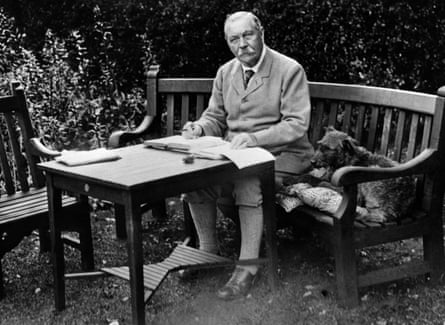
You might expect modern audiences to be wholly on Houdini’s side. But Conan Doyle will be played by Haig himself, who as an actor has won the nation’s heart with all his buttoned-up bureaucrats and establishment Englishmen struggling to keep their upper lip stiff. It’s crucial, he tells me, that audiences sympathise with Conan Doyle, and don’t see his faith as an object of ridicule. “He was seeking a religion that was scientifically based. At the time, it was thought that electromagnetism might absolutely be a means to contact the spirits of the dead. That may now seem ludicrous, but the energy of Conan Doyle’s optimism was always engaging. Hopefully there are lots of laughs in the play, but one of the great challenges is to ensure that element is not played as comedy.”
What interests Haig, in a play he says is all about ambivalences, is that both characters had mixed feelings about their own fame: “Houdini wanted not to be an entertainer but a great writer – like Conan Doyle.” And Conan Doyle felt his most beloved creation, Sherlock Holmes, to be far beneath him: “He was like a great Shakespearean actor trapped in a sitcom all his life.” There’s ambivalence too – hence the show’s title – about the distinctions between faith and fakery. “That’s another theme of the play: how do you define the word ‘magic’? What do you mean by it? Is a spiritual faith a form of magic? Or does it require deception and fakery to be magic?”
Haig approaches all this material, he tells me, from a position of lifelong rationalism. Not for him any sentimentality about how writers get their ideas for plays. “Unless you feel this deep calling to write about something specific,” he says, in defence of his Googling, “you need a little bit of help along the way!

“In Magic, I am playing someone with profound faith, and yet if an atheist can be a profound atheist – well, that’s me. And yet, when people are at their most certain, they’re also suspect, aren’t they?” His grandmother attended “a huge number” of seances, he says – but he has attended none. “I would go to one; I’d be fascinated. But I haven’t, I don’t know why.” But there is in his work an enduring interest in bereavement and the lingering presence of the dead. My Boy Jack was likewise about a son killed in the first world war, a coincidence Haig seems surprised to hear me point out – and which he ascribes in part to the death of his own sister at the age of 22.
That was 44 years ago; Haig is 70 now and contemplating if not mortality then at least redundancy. “I think this may be [my last play],” he tells me, if uncertainly. “How long do you go on for? How secure is it as you move through your 70s? You think of McKellen and Dame Judi Dench, still faultless as performers. But that’s not the case for everyone. So I just don’t know where it’s going to head yet.” But if it were all to stop now, Haig would look back on a satisfyingly distinctive career, the master of not one theatre-making craft, but two. “I would be very, very reassured,” he pronounces, with characteristic English understatement, “that things have, on the whole, been fulfilling.”
-
Magic is at Chichester Festival theatre, 24 April-16 May