3 months ago
109
3 months ago
109
Starmer says he hopes ban will come into force around springtime next year
Starmer is now taking questions.
Q: When will this start?
Starmer says the government can move quickly.
We took powers, earlier this year to make sure we could move at speed.
I was very conscious that with the Online Safety Act it took the last government eight years from sort of identifying the beginnings of the problem to actually passing legislation, and [I] was determined that will not happen in this case.
He says legislation already passed gives ministers the powers to act using secondary legislation.
He says:
We hope to pass regulation before Christmas, and therefore to bring the ban into force in the early part of next year, probably about springtime, so we can move a real pace here.
Key events
At his press conference, and in his interview on ITV’s This Morning, Keir Starmer stressed his respect for Ian Russell, whose daughter Molly died aged 14 after seeing harmful content online. The Molly Rose Foundation was set up in her memory.
Its chief executive, Andy Burrows, has just released this statement about the announcement this morning.
The prime minister has chosen to gamble on an unenforceable social media ban that will quickly unravel. When that happens parents and children will ask why he chose not to follow the evidence but take the politically expedient option instead.
A social media ban will fail to tackle fundamental product safety risks issues and leaves parents with a false sense of safety. A majority of children will continue to use high risk sites that will have no incentive to implement robust protections.
This is not what online safety experts believe will work and is necessary. Keir Starmer has chosen to abdicate responsibility for tackling harmful algorithms and his legacy will be setting back children’s safety by years.
Q: Have you got an 80th birthday present for Donald Trump?
Starmer said he did have a present for him, but he would keep it secret until he gave it to Trump. But he did wish him happy birthday when they spoke yesterday, he said.
Starmer said politicians “have to control disinformation”.
Starmer restates his intention to fight any leadership challenge after Makerfield byelection
Shephard turns to the Makerfield byelection.
Q: Do you want Andy Burnham to win the byelection.
Yes, said Starmer.
Q: So what will happen if he challenges you?
Starmer said he did not think there should be a leadership challenge.
But, if there is one, he will fight it, he said.
He said he was elected two years ago with a mandate to serve for five years.
He said he always said change would take time. He completely understood why people want that to happen more quickly.
Starmer said his son was 17 and his daughter 15. She would be affected by the ban, he accepted. He said her views on this policy were “slighly mixed”.
But he and his wife Victoria had always wanted their children to be happy and confident, or happy and safe, he said.
But social media does not make children happier, he said.
Keir Starmer is being interview on ITV’s This Morning. The presenters are Ben Shephard and Cat Deeley.
Q: You used to be against a ban. Why did you change your mind?
Starmer repeated the point he made at his press conference about starting the consultation with an open mind.(See 8.35am.)
He said he spent a lot of time with parents who have lost children through social media.
He said all parents want their children to be safe and happy. But social media does not make them safe or happy, he said.
Shephard then asked about Ian Russell, and played a clip of Russell describing Starmer as a “nowhere politician” who was just cherry picking from the consultation.
Starmer stressed his respect for Ian Russell, as he did at his press conference earlier. (See 9.02am.)
When it was put to him that Russell thought this ban would let social media companies off the hook, because it covered access to social media, not the content available on social media, which Russell views as the real problem, Starmer said the government was looking at restrictions on children up to the age of 18, going alongside the ban for under-16s.
He said it would be hard for children used to social media.
But, in future, he said he hoped this ban would lead to children becoming teenagers no longer having an expectation of being able to access social media.
Keir Starmer’s social media ban for under-16s has not been universally welcomed. Campaigners focusing on privacy and individuals’ rights have expressed concerns, or outright opposition.
James Baker, the freedom of expression programme manager at the Open Rights Group, which campaigns for freedom of speech online, said:
These headline-grabbing proposals by a prime ministers on his way out fail to address the root causes on online harms – business models that reward harmful content …
Over 16s in the UK will have to hand over identity documents or biometric data to unregulated age verification companies. The government has completely failed to acknowledge the harms that could come from that.
Kerry Moscogiuri, chief executive of Amnesty International UK, said:
This is a case of the right diagnosis but the wrong prescription …
The problem is not that children exist on social media; it’s that social media companies have built platforms that are unsafe by design. Banning under-16s risks treating children as the problem rather than addressing the companies and systems that create the risks in the first place.
Young people deserve to be safe online, but they also have rights. Social media can expose children to harm, but it is also where many young people learn, connect with friends, find support, organise around issues they care about and make their voices heard.
And this is from Jack Coulson, head of advocacy at Big Brother Watch.
The British people have always, rightly, rejected mandatory ID schemes. Now the government is imposing digital ID checkpoints for the internet. This is not like Challenge 25 for alcohol. We will all face a “papers, please” demand to get online.
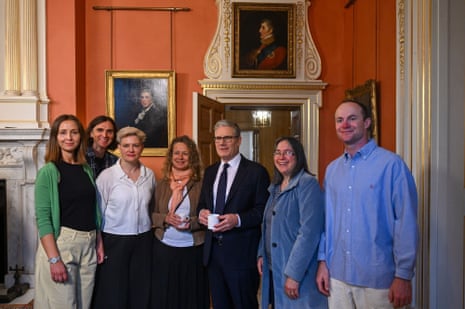
'Watershed moment for child protection' - children's charities welcome social media ban for under-16s
Charities that work on behalf of children have welcomed the government’s announcement.
Chris Sherwood, chief executive at the NSPCC, said:
Today is a win for children and parents and all of us who have campaigned for better child protection online. Big Tech must not have access to our children where their dangerous platforms are causing appalling harm to young people. This is a watershed moment for child protection.
And Lynn Perry, chief executive of Barnardo’s, said:
For too long, children have been put in harm’s way – left to navigate an online world, and the risks that come with it, alone. So we welcome the government’s decision to take decisive action in making the online world a safer place for children.
Ofcom says it is ready to enforce the new social media rules announced by Keir Starmer.
In a statement, a spokesperson for the communications regulator said:
So far, Ofcom has driven some of the strongest changes of any online safety regulation in the world, from widespread age checks to grooming protections for children.
But the industry needs to go much further to make people safe.
The government has entrusted us to build on this progress with new measures to protect children, and we’re ready to work closely with them as the detailed regulations take shape.