1 month ago
119
1 month ago
119
The captivating blue glow emitted by a sea-dwelling species of algae has been harnessed by scientists in the US to make light-emitting structures.
Pyrocystis lunula is a bioluminescent single-celled organism that sometimes produces brief flashes of blue light. Large clumps of the algae are known to emit sparkling displays in waves breaking against beaches.
Giulia Brachi, of the University of Colorado Boulder, had been experimenting in a darkened laboratory, looking for a way to cause the algae to give off a more sustained glow. “We were trying to squish them very slowly,” said Brachi, explaining how she and her colleagues had attempted to replicate the mechanical stress of waves. “They weren’t really responding to that.”
Other researchers have had success with such an approach but one downside is that mechanical stimulation can be difficult to control. So Brachi and her colleagues tried another tactic. Previous studies indicated that when the algae were exposed to acid, the pH level within the light-emitting part of their cells dropped, triggering light production. Brachi added a slightly acidic solution to a glass lab flask containing the algae.
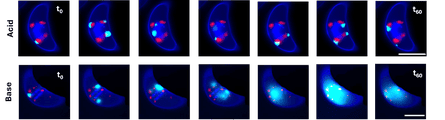
“I was like: ‘Wait a moment, is that the light [reflecting] from a laptop?’” she said. Rather, the algae inside the flask had taken on an appearance like living glitter. In a paper published in Science Advances, she and her co-authors describe how they were able to induce glowing for up to 25 minutes at a time.
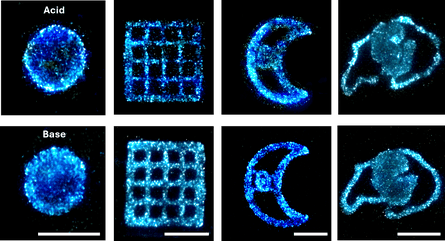
The scientists encapsulated the algae within a hydrogel – a jelly-like substance made with water – and were able to 3D-print various blobby shapes with it, including a crescent moon, in homage to the algae’s appearance under a microscope. All the shapes glowed a strong cyan shade of blue.
Bioluminescent algae contain an enzyme called luciferase, which reacts with a light-producing compound called luciferin – these names come from the Latin “lucifer”, or light bearer. “They’re pretty self-sustaining provided that they have access to seawater,” said Prof Wil Srubar, also of the University of Colorado Boulder.
Srubar suggested that this “living light” could be used for glowsticks or glowing bracelets at raves. Or the algae could theoretically be embedded within biosensors that glow when they detect toxins in the environment.
Prof Chris Howe, of the University of Cambridge, who was not involved in the work, said: “Moving it from what works under controlled conditions in the lab to what works in the real world will be a challenge – but this is a really interesting first step.”
He added that for small, light-emitting devices that rely on disposable batteries, switching to bioluminescence in some cases could drastically reduce the waste created when those batteries run out of juice.
That acid induces bioluminescence in certain algae species is well known, said Anthony Campbell, a professor emeritus at the University of Cardiff. He said he was sceptical the algae could survive for long in the solution used in the study, which had a pH of 4. That’s about as acidic as a tomato and “they don’t like it, it stresses them”, Campbell said.
One mystery remains. Scientists still don’t know why algae such as Pyrocystis lunula evolved to emit light in the first place. It could be that their sparkling displays play a defensive role, perhaps deterring organisms that would otherwise eat the algae.
Howe said: “To my mind, that’s a fairly plausible explanation – but it’s certainly not known for sure.”